
 English
 Spanish
 Arabic
 Chinese
 French
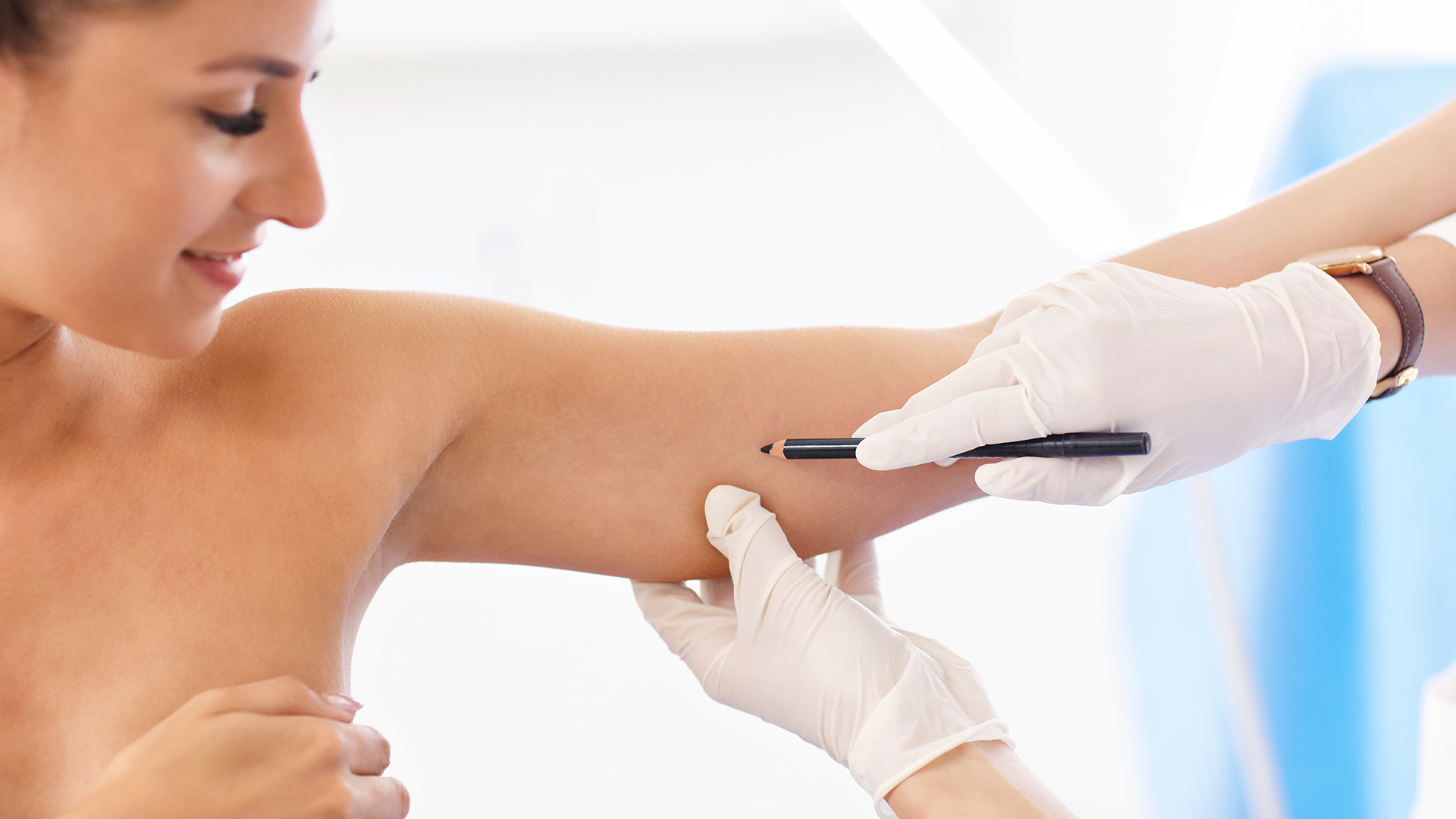
SkinTight™ arm assessment
An Arm Tight consultation is not simply a check for “loose skin”. It is where we identify which tissue is creating the concern, examine whether controlled subdermal radiofrequency could make a proportionate difference, and decide whether treatment, another approach or no procedure is the safer and more realistic plan.
Upper-arm contour can be influenced by skin laxity, superficial fat, muscle shape, scars, previous liposuction, weight change and natural asymmetry. Swelling, a lump, altered sensation or a vascular or lymphatic problem may also change the assessment. These findings are not interchangeable, and one treatment cannot be expected to correct all of them.
Our consultation therefore focuses on diagnosis before device choice: what can reasonably be addressed, what will remain, what risks matter for the individual and whether the proposed change justifies an invasive treatment.
What the consultation needs to establish
SkinTight™ Arm Tight uses a specialised radiofrequency cannula to deliver controlled heat beneath the skin. Our procedure page describes it as an option intended to encourage tissue contraction in selected adults with mild to moderate arm laxity; small superficial fat areas may also be considered where clinically appropriate. Treatment is performed with local anaesthesia and is not the same operation as surgical arm-lift skin excision.
That description is a starting point, not a diagnosis. During consultation we must decide whether the visible concern is mainly superficial laxity and whether its extent is compatible with a modest, variable contraction response. We also consider whether the person’s goal depends on removing skin, reducing a larger volume of fat or correcting another feature that Arm Tight is not designed to change.
Concern
What is creating the contour?
We separate skin laxity from fat volume, muscular shape, scar tethering, swelling and other findings.
Capacity
Can the skin respond?
Skin quality, recoil, stretch, previous treatment and the amount of redundancy influence the likely scale of change.
Safety
What changes the risk?
Health, medicines, nicotine use, scars, altered sensation and lymphatic history may affect treatment or healing.
Expectation
Would the change be worthwhile?
We compare the requested outcome with a realistic non-excisional result, including the possibility of limited or uneven improvement.
Skin, fat, muscle or swelling?
People often use “loose arms” for several different anatomical patterns. A soft fold that can be pinched may contain both skin and fat. A lean arm may have thin, crepey skin but little tissue for a cannula-based contouring procedure. A firm prominence may follow the underlying muscle. A one-sided increase in size may be swelling rather than a cosmetic contour problem. The consultation should not collapse these differences into one label.
| Finding | What the assessment considers | Treatment boundary |
|---|---|---|
| Mild to moderate laxity | Skin quality, recoil, distribution and the amount visible with the arm relaxed and raised. | May fit the intended Arm Tight assessment, but improvement is not guaranteed. |
| Superficial fat | Thickness, distribution and whether reducing it could expose or worsen skin laxity. | Small areas may be considered; this is not general weight-loss treatment. |
| Marked redundant skin | The amount of hanging tissue, fold position and whether contraction could meet the goal. | Radiofrequency does not excise skin; brachioplasty may be the more relevant comparison. |
| Muscular contour | Whether the apparent shape follows the triceps, biceps or shoulder rather than the skin envelope. | Arm Tight does not build, reposition or reshape muscle. |
| Swelling, mass or focal pain | Onset, one-sided change, tenderness, circulation, lymphatic history and other symptoms. | Unexplained findings need appropriate medical assessment before cosmetic treatment. |
No home pinch test can determine suitability. Pinching only shows that tissue can be grasped; it does not identify every tissue layer, predict a radiofrequency response or establish whether the risk is acceptable.
How the arms are examined and mapped
Both arms should be assessed even if only one is the main concern. Natural differences in circumference, skin folds, shoulder position and fat distribution are common. Recording them before treatment helps distinguish a pre-existing asymmetry from a later change and allows each side to be planned on its own findings.
We may observe the arms beside the body, extended and raised. Changing position shows how gravity and movement alter the fold and where the laxity begins and ends. Examination can include skin thickness and recoil, superficial fat, scars, stretch marks, tenderness, sensation and contour transitions near the armpit, lateral chest and elbow. Photographs may be discussed for clinical records with appropriate consent and data handling.
Stage 1
Listen
We clarify the feature, the situations in which it is noticed and the scale of change the person would regard as meaningful.
Stage 2
Compare
Each arm is assessed in more than one position, with pre-existing asymmetry, scars and surface landmarks documented.
Stage 3
Define
The principal layer—skin, superficial fat or another finding—is identified, with areas that should not be treated kept outside the map.
Stage 4
Decide
We compare options, recovery, scars and risks, then decide whether a treatment plan is proportionate or should be deferred.
A proposed map is not a promise to treat every visible area. The upper arm contains important neurovascular and lymphatic structures, while the axillary and elbow regions require particular care. The treating clinician determines the safe boundaries after examination.
Medical history and reasons to postpone
A cosmetic concern still requires a medical history. We ask about general health, allergies, skin disease, infection, healing problems, diabetes, immune or connective-tissue conditions, bleeding risk and relevant medicines or supplements. Nicotine exposure matters because it can impair circulation and healing. Pregnancy and breastfeeding, active infection, open wounds or uncontrolled illness may make elective treatment inappropriate for now.
Arm-specific history is equally important: prior liposuction or energy treatment, surgery, trauma, burns, scars, altered sensation and episodes of infection can change the tissue planes. Breast or axillary surgery, lymph-node removal, radiotherapy or known lymphoedema must be disclosed because they may affect drainage, sensation and procedural risk. A clinician may need further information or another professional’s assessment before deciding whether to proceed.
| History or finding | Why it matters | Possible outcome of assessment |
|---|---|---|
| Ongoing weight change | Further loss or gain can change both the skin envelope and fat distribution. | Planning may be postponed until the contour is more stable. |
| Previous liposuction or scarring | Fibrosis, variable tissue thickness, tethering or altered sensation may be present. | The map, technique or suitability may change after examination. |
| Lymph-node surgery or radiotherapy | Lymphatic drainage and tissue quality may be altered, with a different risk profile. | Further records or specialist advice may be needed; treatment may be unsuitable. |
| Medicine or bleeding risk | Some medicines and supplements affect bruising, bleeding, infection or healing. | The prescriber’s advice may be required; medicines must not be stopped independently. |
| New one-sided swelling or lump | The cause may be medical rather than cosmetic and should not be masked by treatment. | Cosmetic planning stops until the finding has been appropriately assessed. |
The consultation is not a substitute for urgent care. Sudden arm swelling, especially with chest pain, breathlessness, coughing blood, faintness or severe illness, requires urgent medical attention rather than a cosmetic appointment.
Building an individual treatment plan
If the assessment supports Arm Tight, the plan should define the exact area, the intended tissue effect and the limits. It should also explain local anaesthesia, entry points, likely treatment time, aftercare, reviews and what help is available if there is a concern. Our procedure information gives an approximate treatment time of two hours, but the individual plan and treating clinician’s instructions take priority.
The plan may not be identical on both sides. Treating unequal anatomy with identical markings can preserve rather than reduce asymmetry, while pursuing perfect symmetry can lead to overtreatment. We discuss a realistic range, not a guaranteed circumference reduction or a fixed amount of tightening.
| Planning point | What should be agreed | What should not be assumed |
|---|---|---|
| Target | Whether the priority is skin contraction, a small superficial fat area or both. | That every part of the upper-arm contour will change. |
| Map | The boundaries of treatment, entry points and areas kept outside the plan. | That the axilla, elbow or lateral chest is automatically included. |
| Recovery | Compression, wound care, work, driving, exercise and review instructions. | That downtime is identical for every person or every treatment extent. |
| Outcome | The likely scale and timing of change, uncertainty and alternatives. | Perfect symmetry, scar-free treatment or a guaranteed number of sessions. |
Our current procedure information says compression may be advised for approximately one to three weeks and that one or two sessions, several months apart, may be considered. These are indicative possibilities rather than a prescription for every patient. Recovery and the need for any further treatment depend on the treatment extent, healing and the result after sufficient time has passed.
Where clinically appropriate, we may discuss arm liposuction, PLLA, hyaluronic acid-based treatment or Morpheus8 as additional or separate options. None is automatically included. Each targets a different feature and requires its own indication, consent, limitations and risk discussion. Our article on local anaesthesia and SkinTight™ Arm Tight explains what patients may feel during and after treatment.
Alternatives and the limit of non-excisional tightening
A consultation should compare like with like. Choosing no treatment is always an option. When skin change is mild, accepting the contour or using clothing and exercise for general wellbeing may be reasonable, although exercise changes muscle conditioning rather than removing excess skin. When fat is the main target, a fat-reduction discussion may be more relevant. When there is substantial redundant skin, surgical brachioplasty is the procedure that physically removes skin, with longer scars, different recovery and surgical risks.
Published arm-contouring literature is limited and includes small studies of radiofrequency-assisted techniques. It suggests that careful classification by skin laxity, fat and tissue quality is important, and that patients with greater skin excess may still require excisional surgery. This evidence does not establish a universal result for a branded clinic protocol or allow an individual outcome to be predicted from photographs.
A scar trade-off, not a simple hierarchy
Arm Tight avoids the long excisional scar of brachioplasty, but that does not make it a smaller version of the same operation. It cannot remove a broad skin fold. Brachioplasty can remove more tissue but creates a longer permanent scar and has a different complication profile. The relevant choice depends on anatomy, risk tolerance and the result that would make treatment worthwhile.
Risks, recovery and safety-netting
Possible effects and complications include pain or tenderness, redness, swelling, bruising, bleeding, infection, burns or other thermal injury, blistering, skin damage, delayed healing, pigmentation change, scarring at entry points, prolonged firmness, nodules, contour irregularity, asymmetry, fluid collection, temporary or persistent altered sensation, an unsatisfactory result and the need for further treatment. Individual risks depend on anatomy, health, scars, previous procedures and the extent of treatment.
If an injectable or another procedure is proposed, its risks are additional rather than absorbed into the Arm Tight consent. For example, inflammatory reactions, nodules and rare vascular complications require a separate discussion where relevant.
Contact us promptly for an unexpected or worsening change
After treatment with us, contact our clinical team promptly for severe or increasing pain, rapidly worsening or markedly one-sided swelling, persistent bleeding, spreading redness, fever, pus, blistering, pale or dark skin, wound breakdown, new weakness or a major sensory change.
Call 999 for breathing difficulty, chest pain, collapse, signs of a severe allergic reaction or another life-threatening emergency. NHS 111 can advise when urgent help is needed but the situation is not immediately life-threatening.
GMC guidance expects doctors offering cosmetic interventions to discuss benefits, material risks, alternatives and the option of no treatment, to obtain consent responsibly and to give patients time to reflect. A consultation should support a voluntary decision; it should not create pressure to book.
Frequently asked questions
Do both arms need to be examined if only one is a concern?
Why are the arms assessed in different positions?
Can a pinch test confirm that I am suitable?
Can unequal arms have different treatment plans?
Is marked loose skin after major weight loss suitable for Arm Tight?
Is arm fat the same as arm skin laxity?
Can exercise tighten loose upper-arm skin?
Should unexplained one-sided swelling be assessed first?
Why disclose lymph-node surgery or radiotherapy?
Does previous arm liposuction affect consultation?
Do stretch marks rule out Arm Tight?
Does weight need to be stable before planning?
Can the consultation confirm the exact number of sessions?
Are liposuction, PLLA, hyaluronic acid or Morpheus8 automatically included?
Why might the plan change or treatment be declined after consultation?
Individual assessment
Identify what is shaping the arm before choosing treatment
Our consultation can distinguish mild skin laxity from fat, muscle contour, scar tissue, swelling or marked skin excess, then explain realistic options, recovery and material risks without committing you to treatment.
Medical and regulatory sources consulted
- Dr Ducu Clinics: Non-Surgical Arm Lift – The SkinTight™ Treatment
- Subdermal radiofrequency treatment for tightening of the upper arms
- Radiofrequency-assisted liposuction for arm contouring: technique and patient selection
- Radiofrequency-assisted liposuction compared with aggressive superficial liposuction of the arms
- A systematic review of subsurface radiofrequency treatments in plastic surgery
- Upper-arm contouring after massive weight loss
- NHS: Choosing who will do your cosmetic procedure
- Care Quality Commission: Choosing cosmetic surgery
- GMC: Guidance for doctors who offer cosmetic interventions
- ASA/CAP: Guidance on marketing cosmetic interventions