
 English
 Spanish
 Arabic
 Chinese
 French
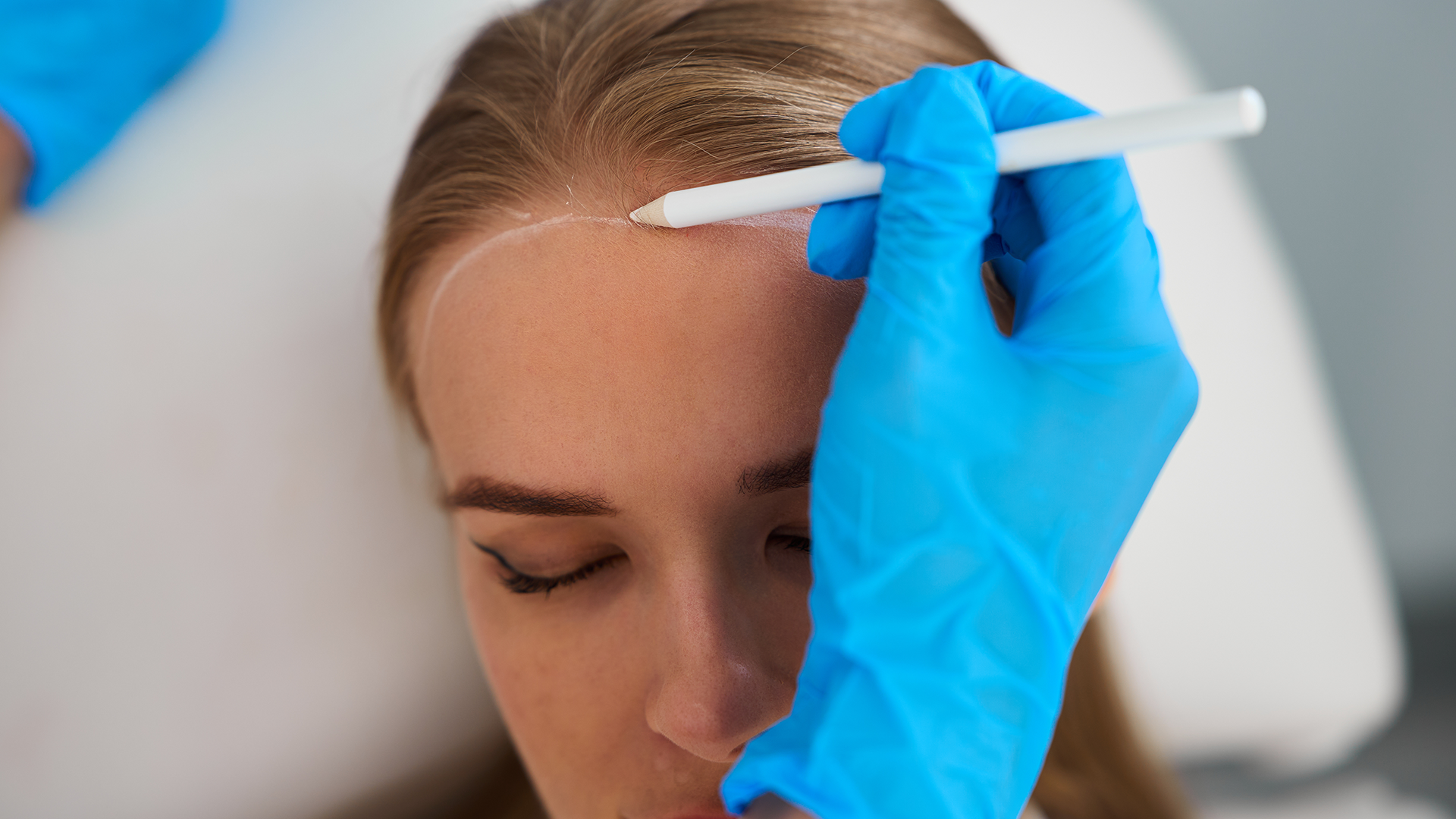
FUE hairline design · Planning principles
A hairline is not one measurement drawn across the forehead. Its height, width, curvature, frontotemporal transitions, irregularities and hair direction must work together—and every extra area included uses follicles from a donor supply that cannot be replenished.
At Dr Ducu Clinics, we design an FUE hairline in relation to the individual face, native hair pattern, existing direction of growth and long-term donor capacity. A line that looks appealing as ink on the skin may be unsuitable if it needs more grafts than the donor area can safely provide, conflicts with the temple hair or would look isolated if native hair recedes.
The aim is not mathematical perfection or an exact copy of another person’s hairline. It is a credible frame for the face that can be constructed with the available follicles and remain supportable as hair and facial features change over time.
A hairline is a three-dimensional frame
Hairline lowering with FUE moves follicular units from a suitable donor area, usually at the back or sides of the scalp, into a planned area in front of or within the existing frontal line. It creates the appearance of a lower or reshaped hairline; it does not remove forehead skin or advance the scalp.
The visible result depends on more than the outline. It is produced by the relationship between the leading edge, the zone immediately behind it, the central forelock, the lateral arms, the frontotemporal recesses and the temporal points. These components are seen from the front, oblique view, profile and above, and they behave differently when the hair is worn forward, parted or pulled back.
Position
Where the frame begins
The central height affects apparent forehead length but cannot be chosen independently of width and donor demand.
Contour
How the line turns
Curvature, peaks, recesses and side transitions determine whether the outline belongs to the face and native pattern.
Emergence
How each hair leaves the skin
Angle, direction, curl and calibre affect softness, styling and the way transplanted hair joins native hair.
Reserve
What remains for later
A first operation must not consume follicles that may be needed if native hair thins behind the new line.
Forehead proportions: references, not formulas
Facial measurements can provide orientation, but no ratio identifies one universally correct hairline. The apparent height of the forehead changes with skull curvature, brow position, temple recession, hairstyle and camera angle. Two people with the same central measurement can need very different outlines because one has a narrow forehead and intact temporal points while the other has broad frontotemporal recession.
We consider the face in full view and profile, not as three equal segments imposed without context. A proposed line should relate to the existing brow, forehead contour, side fringe and native hair direction. Sex-associated patterns, age, ethnicity and personal preference can inform the discussion, but none should become a rigid template or stereotype.
| Reference | What it can show | What it cannot decide |
|---|---|---|
| Central forehead height | A repeatable vertical reference between the brow-glabella region and mid-frontal line. | The width, corner shape, density or total graft demand. |
| Facial thirds | A broad way to compare vertical facial segments. | A mandatory proportion or the best hairline for an individual face. |
| Frontotemporal angles | How the frontal line connects with the side fringe and frames the face. | Whether aggressive closure will remain credible if hair loss progresses. |
| Old photographs | The person’s earlier outline, cowlick, temple pattern and direction of growth. | Whether a juvenile position remains appropriate or sustainable now. |
| Reference images | A preference for softness, shape, width or styling. | A line that can be copied onto different anatomy or donor resources. |
A lower central point does not necessarily make the whole forehead look smaller. If the lateral arms remain high or the temples are wide, the result can appear disconnected. Conversely, closing the corners to narrow the forehead may consume more grafts than moving only the centre.
Contour, corners and controlled irregularity
Natural hairlines are not ruler-straight. They contain larger contour changes and small variations at the leading edge. These irregularities should be controlled and coherent, not random gaps. A perfectly even wall of identical follicles can remain visible as an artificial boundary when the hair is wet, short or pulled back.
The central outline may be softly curved, gently flared or include a widow’s peak where it suits the native pattern. The lateral arms then connect towards the frontotemporal angles. Temple points are separate anatomical subunits with different direction and usually finer-looking hair. Rebuilding them can improve side framing, but it expands the recipient area and is not appropriate merely because a low frontal line has been requested.
Leading edge
Soft transition
Fine single-hair units and a graduated boundary can avoid a dense, plug-like first row.
Frontal body
Visual support
Units with more hairs can be placed behind the transition where appropriate to build apparent fullness.
Corner transition
Continuity, not closure at any cost
The frontal curve must meet the side fringe without creating an unnaturally blunt or isolated angle.
Temple point
A different directional zone
Its shape, calibre and downward angle must be planned separately from the frontal hairline.
Why angle and direction matter
A transplanted follicle tends to keep producing its original type of hair, but the direction in which that hair emerges is influenced by the recipient site. If sites conflict with neighbouring hair, the result may resist normal styling, cross over native shafts or expose the scalp instead of providing coverage. Directional errors cannot be corrected by waiting for more growth.
At the frontal edge, hairs usually emerge at an acute angle rather than standing vertically. Direction changes across the curve and becomes more downward in temporal regions. A cowlick or strong native sweep may require the design to follow, soften or work around that pattern. The safest visual plan is not necessarily one uniform direction across the entire forehead.
| Zone | Design consideration | Risk if ignored |
|---|---|---|
| Mid-frontal point | Forward emergence and any central sweep or peak should relate to native growth. | An upright or contradictory tuft that is difficult to style. |
| Lateral frontal line | Direction curves gradually as the line moves towards each side. | A visible break between centre and corners. |
| Frontotemporal recess | Angle, recession and density should connect frontal and temporal hair without a blunt wall. | Rounded, heavy corners that become less credible with age or recession. |
| Temporal point | Hair lies flatter and points more downward; finer calibre may be needed for softness. | Coarse or projecting hair that looks separate from the side fringe. |
| Behind the leading edge | Direction and density support coverage while blending with existing frontal hair. | Crossing patterns, gaps or a front row unsupported by hair behind it. |
Hair curl complicates the map because the shaft bends after it exits the skin. The curl’s orientation, shaft calibre and colour contrast with the scalp influence apparent density and must be considered when grafts are selected and sites are created.
Turning a line into a graft budget
A drawn line has no density; it becomes a surgical plan only when the area behind it is measured and a distribution strategy is assigned. A small downward movement across a wide forehead can create a substantial recipient zone. Adding both temporal recesses or lowering lateral arms can increase area further, so graft demand does not rise in a simple one-for-one relationship with central millimetres.
The donor estimate is not just a count of visible hairs. We assess follicular-unit density, hairs per unit, shaft diameter, curl, colour contrast, miniaturisation, scars, previous harvesting and the size of a stable donor region. The same graft number can create different apparent coverage in different patients.
| Design choice | Likely demand effect | Trade-off to discuss |
|---|---|---|
| Lower central point only | Adds a frontal band whose area depends on width and curvature. | May not address lateral width or temporal recession. |
| Close both frontotemporal corners | Can add two sizeable zones and require careful transition density. | More graft use and a greater risk of an age-inappropriate outline. |
| Rebuild temporal points | Adds separate lateral zones needing fine grafts and precise acute angulation. | May use valuable single-hair follicles and complicate later recession. |
| Increase frontal density | Uses more units in the same surface area. | Leaves fewer grafts for progression behind the line or another session. |
| Keep a higher, narrower line | Usually reduces recipient area and total graft demand. | Creates a smaller change but may preserve long-term options. |
We use an estimated graft range rather than promising an exact number from a sketch. Final requirements can change after closer donor inspection, trimming, site creation and assessment of usable follicular units. A larger number is not automatically better if harvesting would make the donor scalp visibly thin or reduce future options.
FUE creates multiple small punch scars. Spreading extraction appropriately matters because over-harvesting can produce patchy donor density that becomes visible with short hairstyles. Donor preservation is therefore part of aesthetic design, not a separate technical issue.
Testing the design against future hair loss
Transplanted follicles do not stop biological hair loss in non-transplanted areas. If native hair recedes behind a densely built, low line, a visible gap or isolated frontal island may develop. The younger the patient or the less certain the pattern, the more important it is to test the design against plausible future change rather than the present photograph alone.
This does not mean that every hairline must be high. It means the position, corners and density should be supportable with the diagnosed hair-loss pattern, family history, scalp findings and donor reserve. Appropriate medical management may be discussed for some diagnoses, but it cannot guarantee stability and does not create new donor follicles.
Three future-view questions
- Would this outline still look credible if the native hair immediately behind it became thinner?
- Would enough donor reserve remain to address a later gap or density loss?
- Would the person accept the design with shorter hair, a different parting or age-related facial change?
Design-related risks and revision limits
General FUE risks include pain, swelling, bleeding, infection, folliculitis, altered sensation, cysts, scarring, shock loss, poor or uneven growth, asymmetry and donor depletion. Design adds another group of risks: a line that is too low, too straight or too dense at the edge; blunt temple corners; incorrect angulation; coarse multiple-hair units at the front; directional conflict; insufficient density behind the leading edge; or an outline that becomes isolated after further loss.
Revision may involve adding grafts, redistributing visual density, removing or reducing conspicuous grafts, laser hair reduction, scarring or more than one procedure. Each revision uses time and may use additional donor hair. A line placed too high can sometimes be lowered later if donor capacity remains; a line placed too low is generally harder to reverse.
Contact us if healing or growth raises concern
After treatment with us, contact our clinical team promptly for severe or increasing pain, persistent bleeding, spreading redness, pus, fever, marked swelling, dark or pale skin, wound breakdown or another unexpected change. Later concerns about direction, density or growth should be assessed at an appropriate review rather than judged during early shedding.
Call 999 for breathing difficulty, chest pain, collapse, signs of a severe allergic reaction or another life-threatening emergency. NHS 111 can advise when urgent help is needed but the situation is not immediately life-threatening.
Our FUE procedure information gives a usual visible recovery range of approximately 7–14 days and notes that results develop over 9–12 months. These are indicative ranges. Growth, maturation, direction, density and scar visibility vary, and no particular cosmetic result can be guaranteed.
Frequently asked questions
Is a lower hairline always a better design?
Does the rule of equal facial thirds determine my hairline?
Why can the central point look right while the full design looks wrong?
Should a transplanted hairline be perfectly symmetrical?
Can a widow’s peak be added or retained?
Does my usual hairstyle affect planning?
How does a cowlick affect the new hairline?
Why are angle and direction different at the temples?
Why are single-hair grafts often used at the leading edge?
Do hair calibre, curl and colour change the graft estimate?
How many grafts does lowering the hairline by one centimetre require?
Why might we leave the temporal corners partly open?
Can limited donor supply change the shape, not just the density?
Can beard or body hair be used for the frontal edge?
Can the drawn design change on the day of surgery?
Individual design
Plan the facial frame and donor reserve together
Our consultation can compare alternative positions and contours, assess native direction and calculate how each design uses the available donor supply before surgery is considered.
Medical and regulatory sources consulted
- Dr Ducu Clinics: FUE Hair Transplant for Hairline Lowering
- NHS: Hair transplant
- Hairline design in hair replacement surgery
- Hair transplant practice guidelines
- Principles and techniques for natural female hairline correction
- Complications in hair transplantation
- Revision of unfavourable results in hair transplantation
- Hair transplantation sustainably planned and performed by the physician
- GMC: Guidance for doctors who offer cosmetic interventions
- ASA/CAP: Guidance on marketing cosmetic interventions