
 English
 Spanish
 Arabic
 Chinese
 French
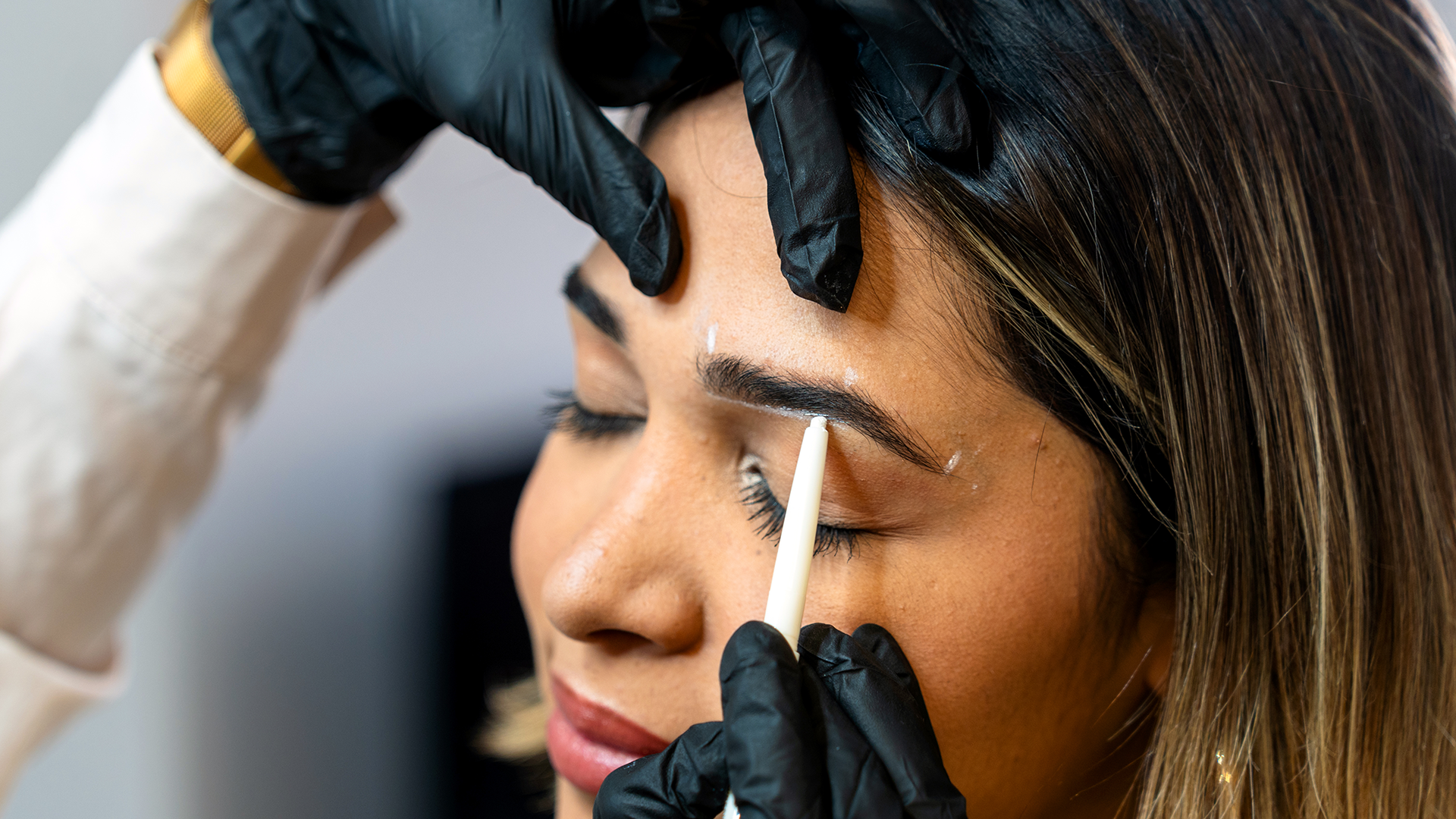
FUE eyebrow transplant · Directional design
An eyebrow transplant is not a process of filling a drawn shape with as many grafts as possible. The eyebrow is a changing pattern of fine hairs: they rise at the head, converge through the body and turn laterally towards the tail, while lying very close to the skin. A graft placed in the wrong direction can remain conspicuous even if it survives and grows well.
At Dr Ducu Clinics, we plan follicle selection, recipient-site angle, direction, curl orientation and distribution together. Graft number matters, but it cannot correct an unsuitable donor match, an elevated exit angle, a block-like head or a tail that points away from the face.
This is why eyebrow anatomy must be mapped hair by hair rather than treated as one uniform strip. Density is the result of overlap, calibre, direction and survival—not simply the total number recorded at the end of surgery.
The eyebrow is made of directional zones
The brow is commonly described as the head, body, arch and tail. These names are useful only if they guide different placement decisions. The medial head usually contains lighter, relatively upright hairs. Through the body, hairs from the upper and lower borders can converge towards a central axis. Beyond the arch, the pattern becomes more lateral and tapers into a less dense tail.
Real eyebrows vary. Some show a clear criss-cross or herringbone arrangement; others have a simpler, more parallel pattern. Age, ancestry, sex-associated characteristics, grooming, scarring and individual anatomy influence shape and density. We therefore inspect the remaining hairs on each side rather than impose a standard diagram.
| Zone | Typical directional change | Planning priority |
|---|---|---|
| Medial head | Hairs may begin more upright, then turn laterally over a short distance. | Keep the transition light enough to avoid a square or brush-like block. |
| Medial body | Upper and lower rows begin to angle towards the central body. | Create controlled overlap without crossing shafts chaotically. |
| Central body and arch | Direction becomes progressively more lateral while borders maintain the outline. | Support apparent fullness while preserving a soft upper edge and coherent arch. |
| Tail | Hairs tend to point laterally and lie flat as the brow narrows. | Use fine units and controlled taper rather than a dense, heavy endpoint. |
| Upper and lower borders | Border hairs can angle towards each other to contribute to the body’s overlap. | Respect the individual pattern; not every brow needs identical cross-hatching. |
The two eyebrows are assessed separately. Facial asymmetry, orbital shape, muscle activity, scar position and remaining hair can make mirrored placement look less balanced in motion. Mapping aims for a coherent pair, not mechanically identical coordinates.
Angle, direction and curl are different variables
Angle describes how steeply a hair exits the skin. Direction describes where it points across the surface. Curl describes how the shaft bends after it emerges. A graft can point towards the tail yet still project too far from the face because its exit angle is too elevated. It can also lie flat initially but curve away as it grows if its natural bend was oriented poorly.
Eyebrow recipient sites generally need to be extremely acute—close to the plane of the skin—so the shafts lie along the brow rather than stand like a canopy. The angle and direction are then adjusted across very small distances. This technical requirement is more demanding than drawing the outer border.
Exit angle
Flatness against the skin
The recipient track influences whether a shaft lies close to the face or projects outward.
Direction
Path across the brow
The vector changes from the medial head through the body, arch and lateral tail.
Curl orientation
Where the shaft bends
The donor hair’s curve should support the planned lay; rotation can make it lift or cross neighbouring hair.
Calibre
Visual weight of each shaft
A coarse hair can look heavy at the edge or tail even when its angle is technically accurate.
Healing also matters. Swelling, crusting and early shaft position do not show the mature pattern. Some orientation can change as tissue settles, and scalp-derived hairs grow longer than native eyebrow hairs. Trimming and grooming can support the result, but they cannot reliably turn a poorly angled follicle into a correctly oriented one.
How placement creates overlap and apparent density
Eyebrow fullness is partly an optical effect. Hairs that lie flat and overlap along a coherent axis can cover skin efficiently. Hairs that stand upright, diverge or leave conflicting gaps may look sparse even when the graft count is higher. This makes placement geometry as important as numerical density.
Recipient sites must be spaced with regard to blood supply, existing follicles, scar tissue and the fragility of newly placed grafts. Increasing sites beyond what the tissue can support does not guarantee greater final density and can increase trauma, graft popping or damage to adjacent follicles.
| Variable | Intended role | Possible problem |
|---|---|---|
| Very acute exit angle | Keeps the shaft close to the skin and allows natural-looking overlap. | An elevated track can make hair project away from the face. |
| Staggered transition | Avoids a solid geometric border at the head, upper edge and tail. | A straight dense row can appear tattooed or plug-like. |
| Converging rows | Creates overlap through the body where the native pattern supports it. | Over-crossing can create tangled or chaotic growth. |
| Density gradient | Builds fullness in the body while allowing a lighter head and tapered tail. | Uniform density can produce a heavy block with no anatomical rhythm. |
| Spacing around native hairs | Preserves useful follicles and blends transplanted and existing patterns. | Crowded sites may injure native hair or compromise recipient tissue. |
The recipient map is therefore a field of vectors and gradients. Two brows can share the same outline and graft count yet look different because their hairs leave the skin at different angles, overlap differently or carry different shaft thickness and curl.
Matching donor follicles to the map
FUE allows individual follicular units to be selected from a suitable donor area. Our procedure information notes that the donor source is commonly the scalp, often near the side of the head or ear, but the most suitable area varies. We compare shaft calibre, colour, curl, growth behaviour and the availability of single-hair units.
Fine single-hair grafts are commonly useful along borders, the medial transition and tail. Some published techniques use selected two-hair units in the central body for fullness, whereas other surgeons prefer single-hair units throughout. There is no justification for applying one rule without considering the patient’s native pattern, donor characteristics, recipient skin and the desired degree of softness.
Inspect
Read the donor hair
Calibre, curl, colour and natural bend are examined rather than inferred from a distant photograph.
Sort
Match unit to zone
The softest units can be prioritised where a coarse shaft would be most visible.
Orient
Work with the curve
Placement considers how the shaft bends so that growth is encouraged to follow the skin rather than lift away.
Maintain
Plan for scalp-hair growth
Established scalp-derived hairs commonly need repeated trimming and grooming over the long term.
Donor dominance means transplanted follicles retain important characteristics of their source. Surgery relocates them; it does not reliably convert long-growing scalp hair into biologically identical eyebrow hair. A technically good direction still requires the patient to accept future maintenance.
Why graft count does not equal result quality
The number of grafts depends on the area being reconstructed, native density, outline, scar quality, donor-hair availability and whether one or both brows are treated. Published reports contain different numerical ranges because their patients, techniques and definitions differ. A headline count cannot be transferred to an individual plan.
More grafts can be unhelpful when they are the wrong calibre, placed at the wrong angle or crowded into tissue that cannot safely support them. Conversely, carefully layered hairs may create useful apparent density with a lower count because their overlap covers the skin efficiently.
| Factor | If well matched | If poorly matched |
|---|---|---|
| Angle | Hairs lie flat and contribute to layered coverage. | Hairs project, exposing skin and appearing coarse. |
| Direction | The head, body and tail form a continuous flow. | Crossing or divergent shafts disrupt the outline. |
| Calibre and unit size | Fine singles soften borders; selected body units support fullness. | Coarse or multi-hair edge grafts can look tufted. |
| Distribution | A gradient creates body, taper and a lighter transition. | Uniform packing creates a block-like brow. |
| Survival | Growth follows the planned pattern with acceptable coverage. | Uneven survival leaves gaps despite the initial count. |
An estimated number is part of informed planning, not a density guarantee. Not every graft survives, and the final pattern cannot be judged from implanted shafts immediately after surgery. Our article on how FUE eyebrow transplantation is planned explains how graft ranges, direction and curl are recorded before surgery.
Native hair, scars and previous pigment
When native hairs remain, their direction provides valuable information and a blending framework. Recipient sites should work around useful follicles, but the underlying condition may continue to affect them. Surgery can also cause temporary shock loss, and transplantation does not treat active inflammatory, autoimmune or scarring disease.
Scar tissue may have altered thickness, mobility and blood supply. It can resist the very shallow tracks needed for flat growth or support fewer grafts in one stage. A scar-based reconstruction may therefore use a more conservative density plan, require a test area or need more than one session after maturation.
Microblading and tattoo pigment can define an outline but do not show follicle direction, tissue perfusion or the correct depth for a recipient site. Pigment may also remain visible between hairs if the new design differs. We assess the actual skin and native hairs rather than using the tattoo as an automatic transplant map.
Directional risks, maturation and revision
FUE eyebrow transplantation creates donor and recipient wounds. Risks include pain, swelling around the brows or eyelids, redness, bleeding, infection, scabbing, itching, altered sensation, folliculitis, cysts, pigmentation change, scarring, temporary shock loss, poor or uneven survival, asymmetry and an unsatisfactory result. FUE avoids a linear donor scar but still leaves multiple small extraction scars.
Pattern-specific problems include hairs that stand away from the skin, point in conflicting directions, curl unpredictably, create an abrupt head, form a heavy tail or grow as visible multi-hair tufts. Some shafts can be trimmed or groomed, but revision may require selective removal, electrolysis or laser reduction, additional grafting or more than one procedure. Removal can itself scar the skin or leave gaps.
Do not judge final direction during early healing
Our procedure information describes initial healing and scab removal at approximately 7–10 days. Transplanted shafts commonly shed in the first weeks, new growth may begin around three to four months and maturation can take approximately 9–12 months or longer. These are indicative ranges, and individual growth varies.
After treatment with us, contact our clinical team promptly for severe or increasing pain, spreading redness, pus, fever, persistent bleeding, worsening swelling, dark or pale skin, visual symptoms or another unexpected change. Call 999 for a life-threatening emergency.
A later review separates true directional problems from temporary crusting, short new growth and grooming effects. Further treatment should not be planned before the pattern has matured sufficiently to understand what actually needs correction.
Frequently asked questions
Do all eyebrow hairs grow in the same direction?
Why must eyebrow grafts lie so flat?
What is the difference between graft angle and direction?
Why does the natural curve of a donor hair matter?
Can a wrongly directed transplanted hair be trained with gel?
Should every hair at the eyebrow head point straight upwards?
What is a herringbone or criss-cross eyebrow pattern?
Why is the eyebrow tail usually lighter than the body?
Are single-hair grafts always used?
Does a higher graft count mean a denser or better eyebrow?
Do remaining native eyebrow hairs influence placement?
Can both brows receive identical graft directions?
Does scar tissue make a flat angle harder to create?
Can a microbladed outline be used as the transplant map?
When can graft direction be judged properly?
Directional planning
Map how each part of the eyebrow should grow
Our consultation assesses native vectors, donor-hair curve, calibre, recipient skin and the density pattern required for the head, body, arch and tail before surgery is considered.
Medical and regulatory sources consulted
- Dr Ducu Clinics: FUE Eyebrow Transplant in London
- Eyebrow and eyelash hair transplantation: a systematic review
- Hair transplant for eyebrow restoration
- The science and art of eyebrow transplantation by follicular unit extraction
- Eyebrow transplantation using long-hair follicular unit excision
- FUE for post-traumatic eyebrow scars: direction and recipient-site planning
- NHS: Hair transplant
- GMC: Guidance for doctors who offer cosmetic interventions
- ASA/CAP: Guidance on marketing cosmetic interventions