
 English
 Spanish
 Arabic
 Chinese
 French
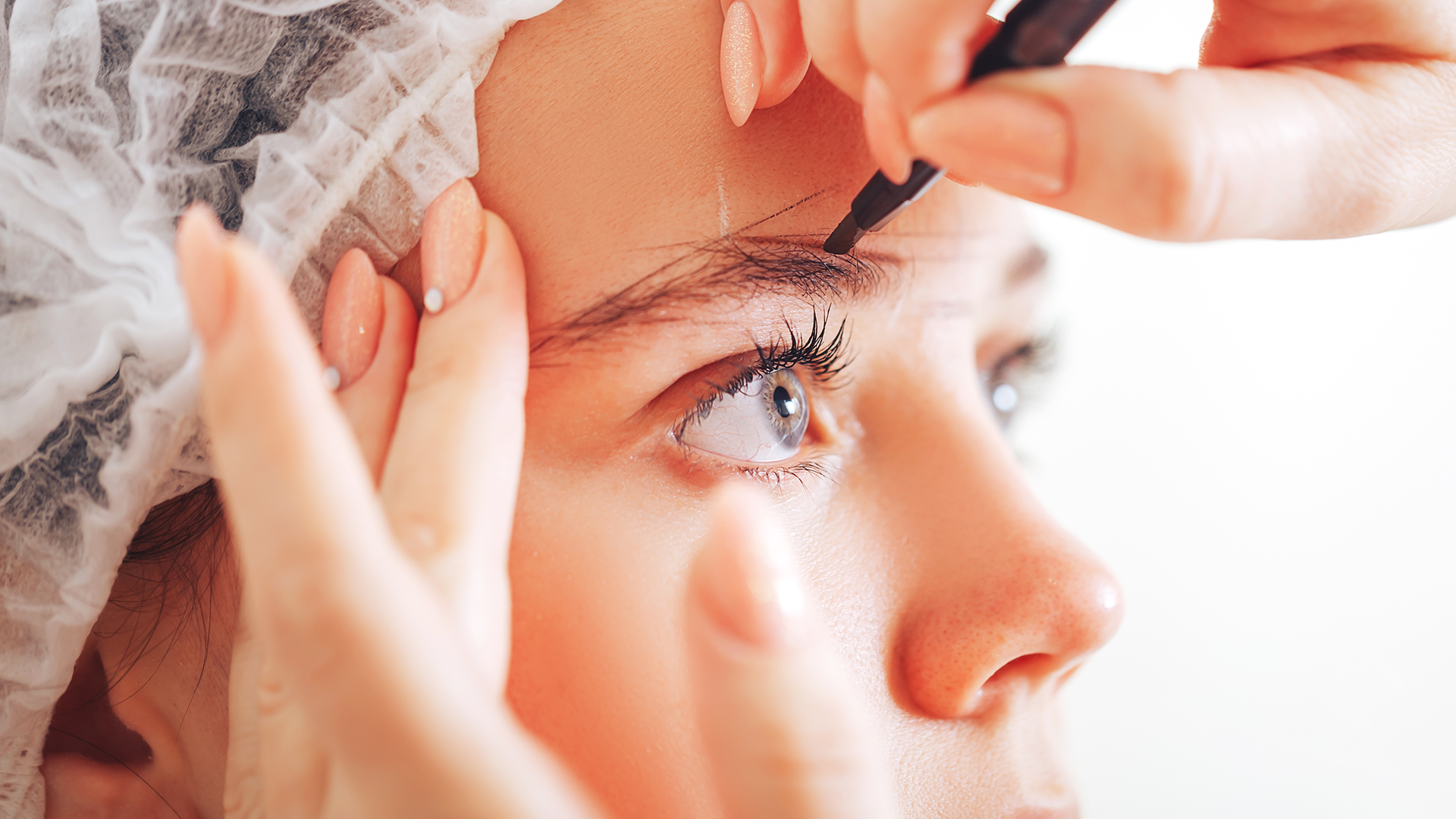
Eyebrow restoration · FUE follicle behaviour
An FUE eyebrow transplant moves living follicles, usually selected from the scalp, into carefully planned sites within the brow. If those follicles establish, they can produce real hair rather than pigment. They do not, however, automatically become identical to native eyebrow follicles: donor-hair calibre, curl and growth length continue to influence the result.
That difference explains why eyebrow transplantation is not simply a matter of adding more hairs. Diagnosis, donor selection, placement angle and long-term grooming all matter. A technically successful graft can still look conspicuous if it is too thick, grows in an unsuitable direction or is not maintained as advised.
The essential idea
A transplanted follicle usually keeps important characteristics of its donor site. Scalp-derived hairs may therefore grow longer than native brow hairs and require regular trimming and grooming. The procedure can redistribute follicles, but it cannot guarantee identical texture, perfect symmetry, a fixed growth direction or survival of every graft.
What an FUE eyebrow transplant actually moves
Follicular unit extraction, or FUE, removes individual follicular units through small circular openings in a donor area. Selected grafts are then inserted into recipient sites created within the planned eyebrow. For the leading edges and fine transitions of a brow, single-hair grafts are commonly important because larger groups can appear coarse or tufted.
The procedure moves follicles; it does not transfer a ready-made eyebrow. The visible result develops only if grafts survive, re-enter active growth and produce hairs that can be blended with any existing brow hair. Density is limited by the number and suitability of available donor follicles, recipient-site conditions and the need to avoid excessive packing.
Dr Ducu Clinics describes its FUE eyebrow transplant as a day-case surgical procedure under local anaesthesia, usually taking around four to six hours. The precise duration and graft requirement depend on the area being reconstructed, the existing brow, donor-hair characteristics and the agreed design.
Why the cause of eyebrow loss comes before design
Sparse eyebrows may be constitutional, but acquired eyebrow loss can also be associated with repeated hair removal, trauma, scarring, inflammatory skin disease, autoimmune alopecia, infection, endocrine conditions, nutritional problems, medicines or other medical causes. Recent clinical reviews emphasise that eyebrow loss is a sign with a broad differential diagnosis rather than one condition.
Stable pattern
Naturally sparse brows
A longstanding pattern may be considered differently from recent or progressive loss, but donor suitability and expectations still require assessment.
Mechanical history
Previous over-plucking
Repeated removal can be relevant, although the remaining follicles and any accompanying skin changes need examination.
Medical cause
Active or reversible loss
An underlying condition may require diagnosis and treatment before transplantation is considered.
Scar assessment
Reduced recipient quality
Scar tissue may have different blood supply and can make graft growth less predictable.
Transplantation is not a treatment for every cause of eyebrow loss. Active inflammatory or scarring disease may damage newly placed follicles, while non-scarring causes can sometimes improve with cause-specific management. When the pattern is new, patchy, symptomatic or changing, diagnosis should take priority over cosmetic reconstruction.
How transplanted scalp hair behaves in an eyebrow
Native eyebrow hairs and scalp hairs are not interchangeable. They differ in typical calibre, maximum length, curvature and growth-cycle behaviour. Moving a follicle changes its location, but the follicle commonly retains donor characteristics. This is why donor selection and realistic maintenance expectations are central to eyebrow transplantation.
| Feature | Native eyebrow hair | Transplanted scalp-derived hair |
|---|---|---|
| Growth length | Normally limited by a comparatively short growth phase. | May continue growing longer and commonly needs trimming. |
| Calibre | Often fine, with regional variation across the brow. | Depends on the donor site and may look coarser if poorly matched. |
| Direction | Changes across the head, body and tail of the brow. | Influenced by recipient-site angle, follicle curl and healing. |
| Maintenance | Usually follows the natural brow cycle and length. | May require repeated trimming, brushing and occasional shaping. |
| Density | Determined by existing follicle distribution. | Limited by graft survival, safe site creation and donor supply. |
Published surgical literature reports that regular trimming is commonly required after scalp hair is transplanted into the eyebrows. The precise frequency is individual: some hairs may need attention more often than others, and growth behaviour can evolve during maturation.
Design depends on angle, direction and curl — not only outline
Eyebrow mapping defines a proposed boundary, but a drawn outline cannot show how individual hairs will sit. Natural brow hairs leave the skin at a shallow angle and change direction across different zones. Recipient sites must therefore be planned as a three-dimensional pattern, not as a flat block of density.
Outline
A design, not a guarantee
Mapping supports discussion of the intended head, arch, body and tail, but healing can affect the final appearance.
Angle
Close to the skin
An overly upright exit angle can make a graft conspicuous even when its position looks correct on a drawing.
Curl
Orientation matters
The natural curve of a donor hair can help or hinder how it lies after transplantation.
Calibre
Fine transitions
Coarser hairs can dominate the border, so suitable single-hair graft selection is important.
No mapping system can promise perfect symmetry. Faces and native brows are naturally asymmetric, while swelling, graft survival, hair calibre and styling can produce further differences. The aim is a coherent design suited to the individual, not a mathematically identical pair.
The FUE eyebrow transplant pathway
Technique and aftercare vary between patients. The following sequence describes the general pathway rather than an individual surgical plan.
Step 01
Assess
The cause and stability of loss, skin, existing brow, health history and donor area are reviewed.
Step 02
Map
The intended shape is discussed alongside asymmetry, hair direction and realistic density.
Step 03
Harvest
After local anaesthesia, suitable follicular units are individually extracted from the planned donor zone.
Step 04
Place
Grafts are inserted into recipient sites planned for position, angle, direction and distribution.
FUE avoids the linear donor scar associated with strip harvesting, but it is not scar-free. Each extraction creates a small wound, and the donor area can look thinned if harvesting is excessive or poorly distributed. Recipient sites also heal as small wounds within the eyebrow area. Our article on local anaesthesia for eyebrow transplantation describes what patients may feel at each stage.
Healing, shedding and new growth are separate stages
Early skin healing is not the same as the final cosmetic result. Dr Ducu Clinics states that initial healing and scab removal usually take around 7–10 days. Swelling, redness, tenderness and scabbing may occur, and visible redness can persist longer for some people.
| Stage | What may be visible | What to remember |
|---|---|---|
| First days | Swelling, redness, tenderness and small crusts may develop. | Avoid rubbing or disturbing the grafts and follow the written care plan. |
| Around 7–10 days | Initial healing and scab removal commonly progress. | Healing varies; do not force crusts off unless instructed. |
| First few weeks | Many transplanted hair shafts shed. | Shedding of the visible shaft does not by itself show whether the follicle has survived. |
| Approximately 3–4 months | New hairs may begin to emerge gradually. | Early growth can be fine, uneven or incomplete. |
| Around 9–12 months or longer | Density, calibre and direction are more mature. | Not every graft survives, and further maturation or review may be needed. |
Generic timelines cannot replace the treating team’s instructions. Advice about washing, make-up, skincare, exercise, swimming, sun exposure and returning to work should be supplied for the individual procedure.
Long-term care: trimming is part of the result
A common misunderstanding is that transplanted hairs will settle permanently at a native eyebrow length. Scalp-derived follicles may continue to produce longer hairs. Once growth is established and the treating clinician confirms that grooming is appropriate, regular trimming may be required to keep the brow within the intended outline.
Length
Expect ongoing trimming
The interval is individual and can change as the grafts mature.
Direction
Brush and observe
Some hairs may need gentle grooming to sit with the surrounding eyebrow.
Density
Judge after maturation
Prematurely adding more grafts can make later density or direction harder to manage.
Trimming changes length, not the angle at which a follicle emerges from the skin. Waxing, plucking or aggressive shaping can also remove or injure hairs, so grooming methods should be discussed with the treating team during recovery.
A second procedure is not automatically required if early growth looks irregular. Growth is asynchronous and the brow can appear uneven during maturation. Review timing should be based on the clinician’s follow-up plan rather than an early photograph.
Transplantation, pigment and cosmetic styling do different jobs
Make-up, tinting and micropigmentation can alter the visible colour or outline of a brow without moving follicles. An eyebrow transplant aims to create three-dimensional hair growth. These options are not interchangeable, and none is automatically best for every person.
| Approach | What it changes | Important limitation |
|---|---|---|
| Make-up or tinting | Temporarily changes colour, contrast or visible shape. | Does not create new follicles or permanent hair growth. |
| Microblading or micropigmentation | Places pigment to simulate strokes or shading. | Pigment can fade or change, and the method does not produce actual hair. |
| Cause-specific medical care | Addresses a diagnosed inflammatory, autoimmune, infectious, endocrine or other cause when appropriate. | Response depends on the diagnosis; treatment must be clinician-led. |
| FUE eyebrow transplant | Moves selected follicles to create hair growth in planned sites. | Requires surgery, donor hair, healing and ongoing grooming; growth is not guaranteed. |
Risks include both surgical complications and an unsuitable hair pattern
Possible problems include pain, swelling, bruising, bleeding, infection, folliculitis, ingrown hairs, cysts, altered sensation, small scars, temporary shock loss of existing hair, donor-site thinning, poor or uneven graft growth and loss of transplanted grafts. Local anaesthetic also has risks that should be discussed during consent.
Eyebrow-specific aesthetic risks include visible plugs, excessive calibre, hairs that project away from the skin, an unnatural direction, asymmetry or a shape that does not blend with the remaining brow. Revision may require further grafting, removal of unsuitable hairs, camouflage or acceptance of additional scarring.
Seek prompt advice if recovery changes unexpectedly
Contact the treating clinic if pain is severe or increasing, bleeding persists, swelling worsens suddenly, redness spreads, discharge or an unpleasant smell develops, fever occurs, skin darkens or breaks down, or there is any unexpected change around the eye. Difficulty seeing, marked eye pain, breathing difficulty or feeling acutely unwell requires urgent medical assessment.
Questions for an eyebrow-transplant consultation in London
The NHS advises people considering hair transplantation in England to check that the clinic is registered with the Care Quality Commission and that a doctor is registered with the General Medical Council. Procedure-specific experience matters because eyebrow transplantation demands different design and placement decisions from scalp restoration.
- What is the likely cause of my eyebrow thinning, and does it need investigation first?
- Which donor area is proposed, and how closely does its hair match my eyebrow calibre and curl?
- Who designs the brow, creates the recipient sites, extracts the follicles and places the grafts?
- How will direction change across the head, body, arch and tail?
- What trimming and grooming should I expect if the grafts grow like scalp hair?
- What happens if some hairs grow too upright, survive unevenly or do not match?
- What follow-up is included, and who can be contacted outside normal hours?
- When would a revision be assessed, and what effect would it have on donor supply and scarring?
Frequently asked questions
Does transplanted eyebrow hair grow like normal eyebrow hair?
Will I need to trim transplanted eyebrow hairs permanently?
Can transplanted hairs grow in the wrong direction?
Does eyebrow mapping guarantee symmetry?
Why are single-hair grafts important?
Can any type of eyebrow loss be transplanted?
How long does the procedure take?
When do the scabs usually clear?
Will the transplanted hairs shed?
When can new growth appear?
When is the result mature?
Is every graft guaranteed to survive?
Does FUE leave no scars?
Is microblading the same as an eyebrow transplant?
Can a second session be needed?
Individual assessment
Discuss donor-hair behaviour before deciding on eyebrow transplantation
A consultation can assess the cause of eyebrow loss, donor-hair match, design, maintenance, alternatives and risks. It does not commit you to treatment.
Medical and regulatory sources consulted
- Dr Ducu Clinics — Eyebrow Transplant London
- NHS — Hair transplant
- Eyebrow Madarosis: An Updated Review of the Etiology and Management, Part I — Nonscarring Disorders. 2026.
- Eyebrow Madarosis: An Updated Review of the Etiology and Management, Part II — Scarring Disorders. 2026.
- Acquired causes of eyebrow and eyelash loss: a review and approach to diagnosis and treatment. 2023.
- The Science and Art of Eyebrow Transplantation by Follicular Unit Extraction.
- Eyebrow and Eyelash Hair Transplantation: A Systematic Review.
- General Medical Council — Cosmetic interventions guidance
- Care Quality Commission — DrDucu London
- ASA/CAP — Guidance on marketing cosmetic interventions
Medical note: This article provides general information and does not replace diagnosis, examination, informed consent or an individual treatment plan. The cause and stability of eyebrow loss, skin health, donor-hair characteristics, medical history and expectations can all change whether transplantation is appropriate. Results, maintenance and recovery vary.